

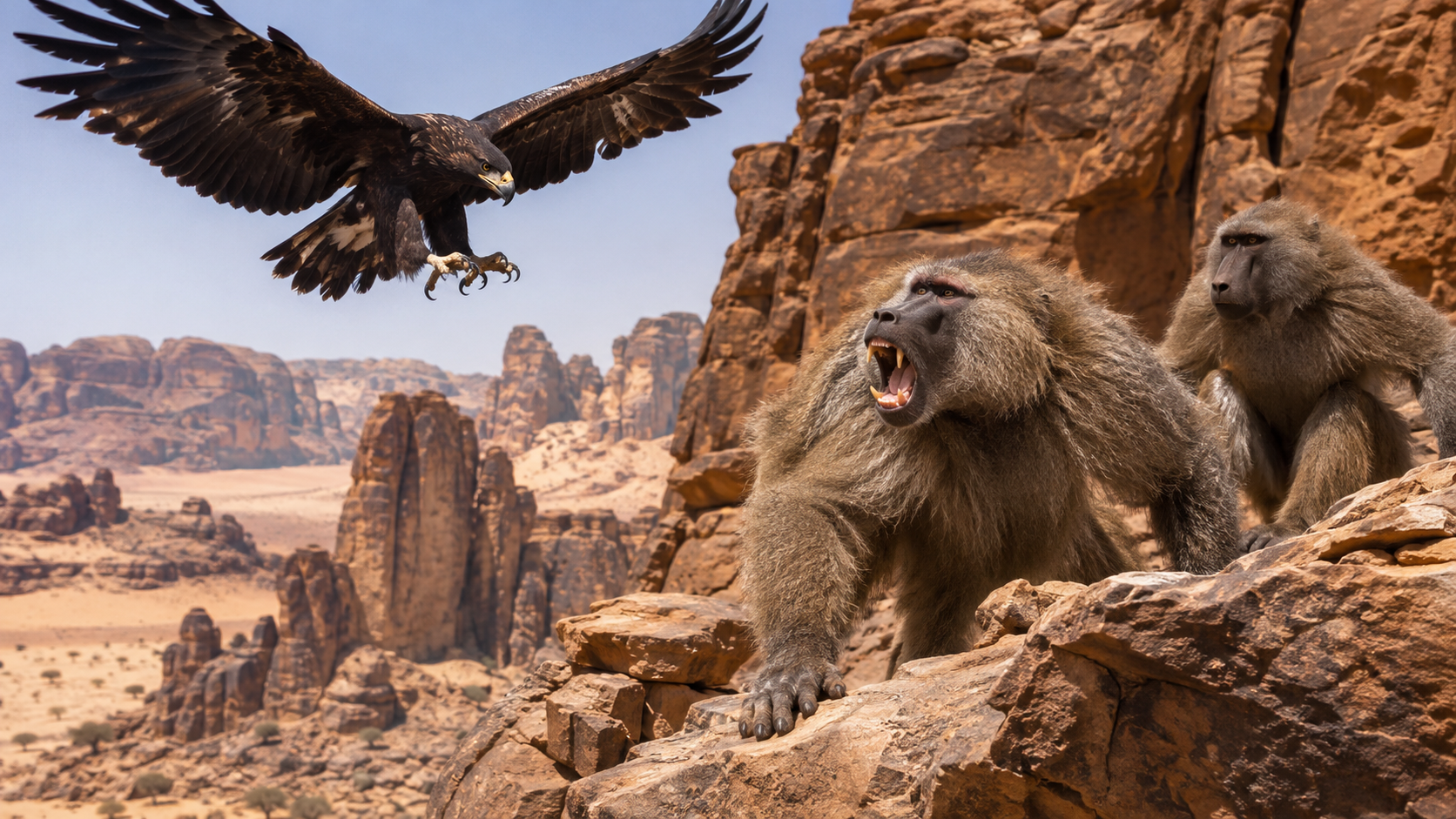
Scientists exploring a remote stretch of the Sahara Desert have uncovered disturbing evidence that enormous eagles may be attacking and killing baboons weighing nearly 60 pounds, a discovery that could change what we know about the dangers faced by our earliest human ancestors.
The startling findings emerged from Chad’s isolated Ennedi Plateau, where researchers studying a little-known population of olive baboons began discovering skulls marked by what appeared to be powerful eagle talons.
At first, the scientists could hardly believe what they were seeing. Some of the baboons were considerably larger than the primates eagles were previously known to kill.
“We saw the eagles while we were searching for the baboons, but we never imagined that they might be a threat to them,” said Catherine Hobaiter, a primatologist at Scotland’s University of St. Andrews.
The mystery deepened as researchers uncovered additional remains bearing similar injuries, including puncture wounds around the eye sockets and distinctive scratches across the shoulder bones.
Their findings, published November 18 in the American Journal of Biological Anthropology, point to an unexpected predator: the Verreaux’s eagle, a powerful bird of prey with a wingspan that can exceed seven feet.
Researchers examined remains representing nine baboons, most of them adult males. The animals weighed an estimated 49 pounds on average, while one particularly large individual was estimated at nearly 58 pounds.
That was an extraordinary finding because scientists had previously lacked confirmed evidence of birds of prey killing primates weighing more than approximately 29 pounds.
The injuries were consistent with attacks by eagle talons, and the researchers believe some could have resulted from deadly encounters rather than scavenging.
However, the study did not capture an eagle killing a baboon, and independent experts have cautioned that the birds could have fed on animals that were already dead or weakened.
Still, the evidence raises an unsettling possibility about human history.
Some early human ancestors were roughly the same size as these baboons, suggesting they might not have been safe from massive birds circling overhead.
For millions of years, prehistoric humans faced threats from powerful predators, including large cats and crocodiles. Eagles may have posed an additional danger, particularly to smaller individuals and those caught alone.
Scientists believe the findings could help explain why early primates developed defensive behaviors, including traveling in groups, sounding warnings and banding together to drive away predators.
The unusual desert environment may also help explain the encounters. With limited vegetation and few places to hide, baboons navigating the exposed sandstone cliffs could be especially vulnerable to attacks from above.
For researchers, the discovery has opened an entirely new mystery surrounding one of Africa’s least-understood primate populations.
The team plans to continue studying the baboons’ behavior, diet and social relationships to better understand how they survive in such an unforgiving landscape.
And while scientists have yet to witness one of these potentially deadly encounters firsthand, the marked bones suggest that even a powerful, nearly 60-pound baboon may have reason to fear what is circling in the sky.
Discover more from
Subscribe to get the latest posts sent to your email.
 What's Up Today Editorial Team