

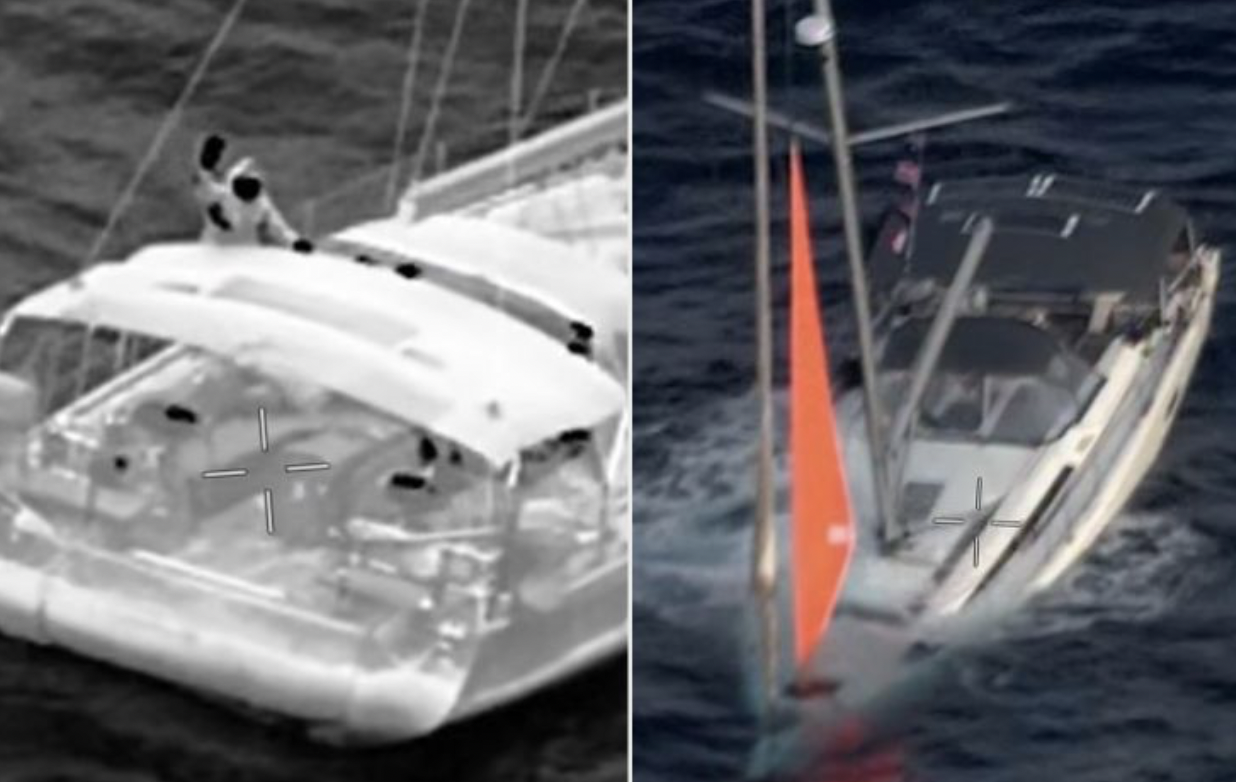
Four sailors were left floating in a life raft in the middle of the South Pacific for roughly 17 hours after their yacht collided with a massive whale and began sinking.
The terrifying ordeal unfolded Saturday, Sept. 26, aboard the Australian-flagged yacht Tai Tam as the vessel sailed through remote waters about 250 nautical miles north of Norfolk Island.
The 51-foot yacht was carrying four people when its crew suddenly encountered several whales.
Jemma Cooper, who was sailing with her husband Jeremy Cooper as part of a months-long voyage, recalled seeing around six whales in the area.
“There was a thud. We knew we’d been hit by something,” she told the BBC.
The impact was powerful enough to throw Jemma across the boat.
She described seeing one or two particularly enormous whales that appeared to be about as long as their yacht.
Within moments, the situation aboard Tai Tam became increasingly desperate.
Water began pouring into the vessel, and the crew attempted to keep the yacht afloat by bailing water and dealing with the damage.
But skipper Jeremy Cooper said it quickly became apparent that they were in serious trouble.
“We managed to mitigate it to some extent but the damage was so bad,” he told ABC Pacific.
After approximately half an hour, Cooper said they realized the yacht was unlikely to be recoverable.
With hundreds of miles of open ocean surrounding them, the crew issued a Mayday call and activated the yacht’s Emergency Position-Indicating Radio Beacon, or EPIRB.
That decision would prove critical.
The four sailors eventually abandoned Tai Tam and climbed into a life raft while rescue authorities scrambled to reach them.
The crew consisted of two Australians, one New Zealander and one French national.
The collision happened in an extremely remote stretch of the South Pacific. Norfolk Island itself sits between Australia, New Zealand and New Caledonia, meaning help could not simply arrive within minutes.
New Zealand’s Rescue Coordination Centre received the emergency beacon alert at approximately 1 p.m. New Zealand time and launched a major response.
A Royal New Zealand Air Force P-8A Poseidon maritime patrol aircraft was sent to locate the stranded sailors.
Once overhead, the aircraft crew established two-way radio communication with the yacht’s crew and helped coordinate vessels that had been diverted toward their position.
Meanwhile, Tai Tam’s situation continued to deteriorate.
The badly damaged yacht ultimately sank, leaving its crew entirely dependent on the life raft and the approaching rescuers.
For hours, the four sailors remained stranded in open water waiting for someone to reach them.
Jeremy later described the circumstances as frightening but said the weather fortunately remained favorable.
“We’re unlucky to have been hit by the whale, but then we were really lucky with the level of the response and the weather,” he said.
Help finally arrived at around 6 a.m. the following morning.
The MV Sofrana Surville, a roughly 470-foot cargo ship that had been diverted to the scene, reached the sailors and pulled all four aboard.
For Jemma, simply reaching the ship’s ladder was an emotional moment after spending the night at sea.
“I was just so keen to make sure I could get my feet on that bottom rung,” she recalled.
Once the final member of their group was safely aboard, the emotion of the ordeal finally caught up with her.
“When that last crew member gets on board and you know that they’re safe, I’ve just burst into tears,” she said.
Remarkably, none of the four sailors was reported injured.
Officials later praised the group for being prepared for exactly the type of emergency every offshore sailor hopes will never happen.
Rescue Coordination Centre Operations Manager Mike Clulow said the sailors “did all the right things” after the collision.
Officials specifically credited the crew’s decision to activate their EPIRB early, allowing rescuers to quickly identify their location in an enormous stretch of ocean.
The emergency beacon sends a distress signal that can be detected by satellites and relayed to search-and-rescue authorities, providing rescuers with crucial identifying and location information.
Without it, finding four people aboard a small life raft hundreds of miles offshore could have been dramatically more difficult.
“This was a well-coordinated and executed rescue,” Clulow said, thanking the New Zealand Defence Force, Australian and New Caledonian rescue authorities, the Sofrana Surville and another private sailing vessel involved in the response.
The exact circumstances of the collision remain less clear.
Officials have confirmed that Tai Tam struck a whale, while the sailors reported encountering a group of whales around the time of the impact. Reports have identified the animals as sperm whales, although the New Zealand Defence Force’s initial account referred simply to a whale.
The incident does not appear to have involved an intentional attack by the animal.
For the Tai Tam crew, however, the distinction mattered little in those first terrifying moments.
One minute they were continuing their voyage across the Pacific. The next, their yacht was filling with seawater and they were preparing to abandon everything for a life raft.
Seventeen hours later, all four were back on solid footing aboard a cargo ship — shaken, exhausted and extraordinarily fortunate to have been found.
Discover more from
Subscribe to get the latest posts sent to your email.