

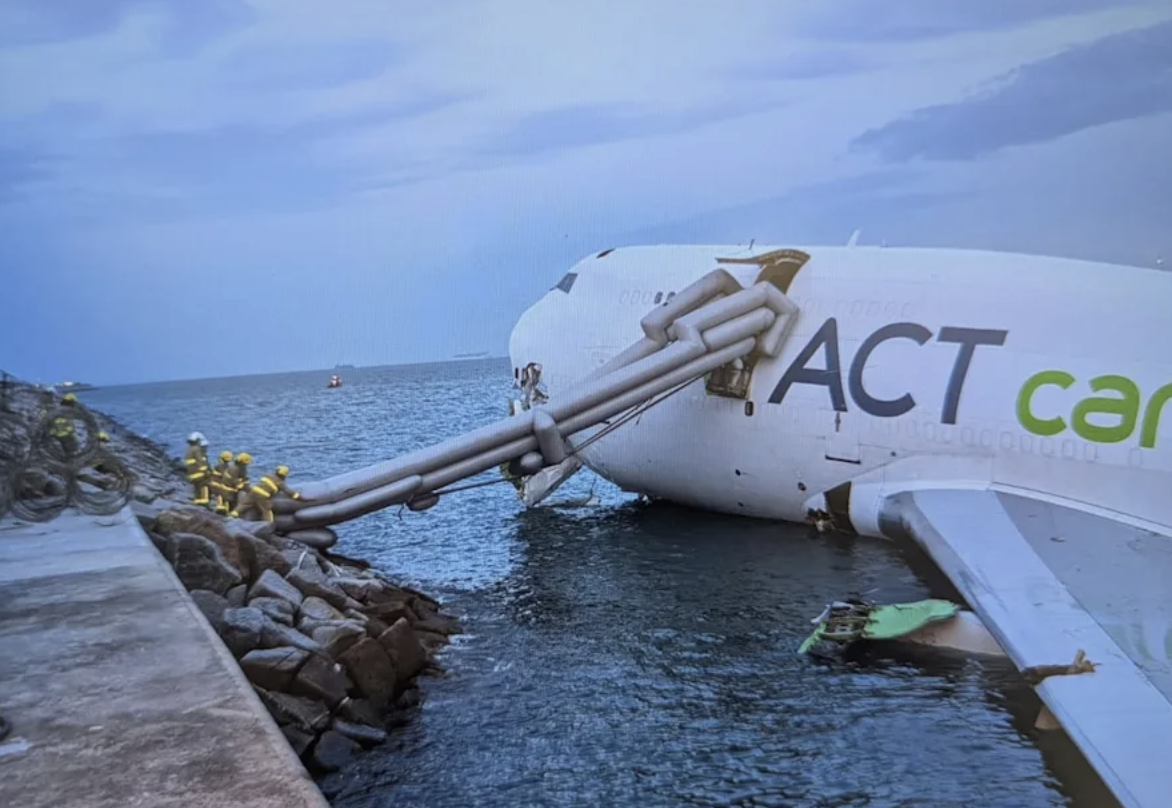
Chaos erupted at Hong Kong International Airport early Monday morning after a Boeing 747 cargo jet skidded off the runway, slammed into a security car, and plunged nose-first into the sea — killing two airport workers and leaving the massive plane partially submerged.
The AirACT Boeing 747-400 freighter, operating under flight number EK9788 from Dubai, reportedly landed around 3:50 a.m. local time when it veered off the airport’s north runway during touchdown.
According to Hong Kong airport officials, the aircraft’s landing gear tore through a security vehicle as it barreled off course. The impact sent the car flying into the water with two security staff trapped inside. Both were killed instantly.
“Four aircraft crew on board were quickly rescued by the Fire Services Department,” said Steven Yiu, executive director of airport operations at Airport Authority Hong Kong. “They also rescued two security staff from the sea. One was certified dead at the scene and the other later at the hospital. We are deeply saddened and extend our condolences to their families. We will provide all necessary support.”
Rescue divers battled darkness and strong currents to reach the wreckage, pulling survivors and victims from the frigid water around dawn.
Shocking images from the scene show the enormous jet’s nose and tail sections torn apart, the fuselage jutting out of the shallow waters just beyond the tarmac. Inflatable escape slides hung from the aircraft’s sides as emergency lights flickered across the waves.
“It looked like something out of a movie,” one witness told local TV. “The front of the plane was completely smashed. I could see crew climbing onto the wing as fire trucks surrounded it.”
The four Turkish crew members, who had departed Al Maktoum International Airport in Dubai earlier that night, were treated for minor injuries. The plane carried no cargo at the time of the crash, according to Emirates Airline, which partners with AirACT on cargo operations.
Investigators say the pilot never issued a distress signal before impact.
“There was no emergency communication received,” confirmed Man Ka-chai, chief accident investigator for Hong Kong’s Air Accident Investigation Authority. “Weather conditions and runway status were both normal.”
Officials are now examining whether a technical malfunction, pilot error, or mechanical failure could have caused the aircraft to drift off the landing strip.
In the aftermath, one Cathay Pacific flight was forced to abort its landing and divert to another runway. The airport’s north runway — one of Asia’s busiest — was shut down for hours as engineers inspected damage and retrieved debris.
The south and center runways remained open, and authorities expect the north runway to reopen after full safety checks are complete.
The Hong Kong crash comes just days after another aviation scare in Europe. A budget Air Arabia Airbus A320 nearly plunged into the Mediterranean moments after takeoff from Catania Airport in Sicily, dropping to within 200 feet of the water before pilots regained control.
That incident reignited global debate over aircraft safety amid increasing reports of runway mishaps and close calls.
The Hong Kong disaster has stunned the aviation community — especially as Hong Kong’s airport is considered one of the safest in the world.
“This is an unthinkable tragedy,” said James McAllister, a former airline safety consultant based in Los Angeles. “The 747 is a workhorse of global cargo, built for stability and endurance. For it to end up in the sea like this raises serious questions.”
Authorities confirmed that investigators are now reviewing flight data recorders and cockpit voice recordings, as well as maintenance logs from the aircraft’s last inspection in Dubai.
As dawn broke over the wreckage, recovery teams continued their grim work along the seawall — a haunting reminder that even the most trusted aircraft can fall victim to fate in seconds.
Discover more from
Subscribe to get the latest posts sent to your email.