

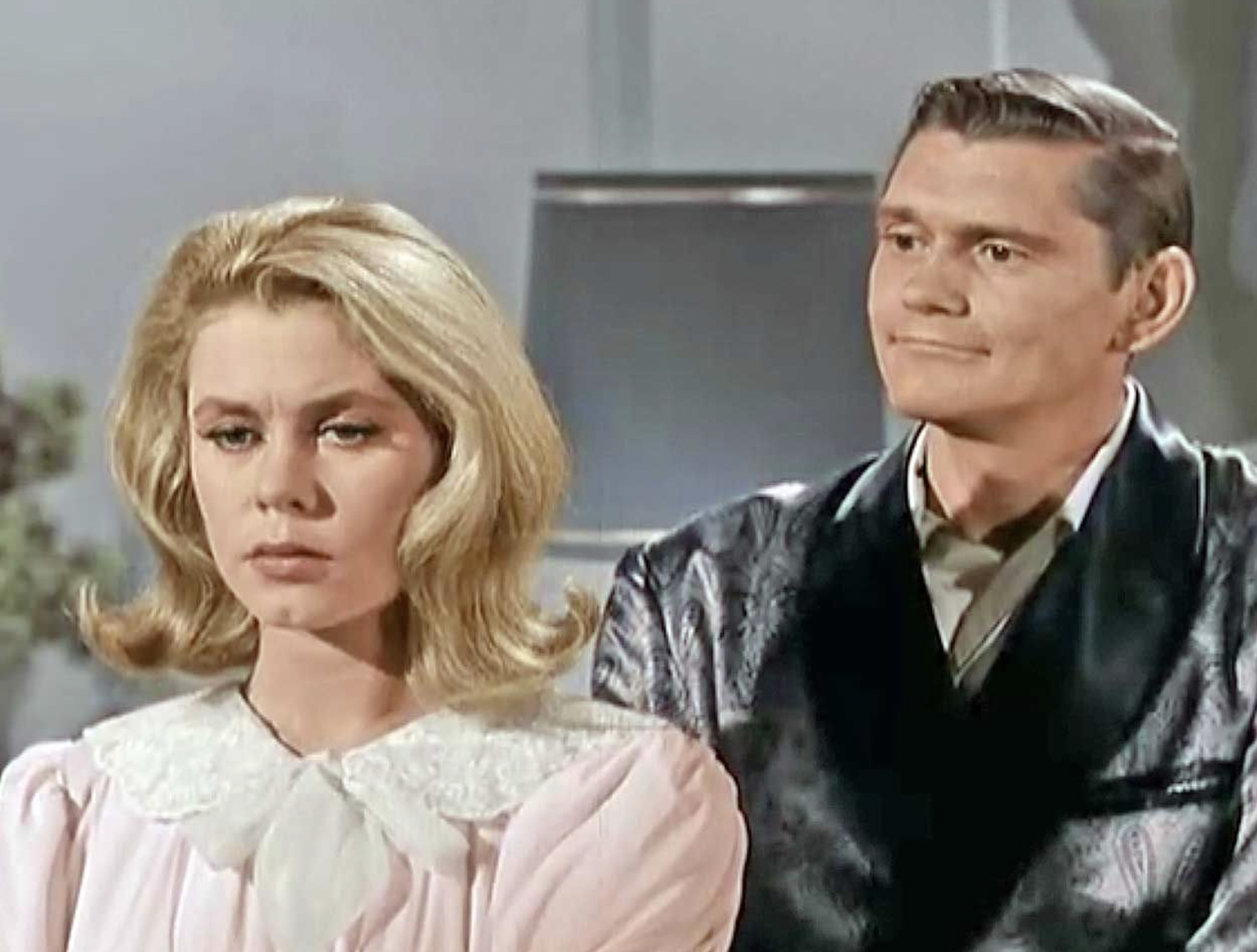
For millions of Americans, Elizabeth Montgomery will forever be Samantha Stephens — the charming suburban witch who could solve almost any problem with a twitch of her nose.
But behind the lighthearted world of Bewitched, Montgomery spent much of her life dealing with complicated family relationships, turbulent romances and the challenge of proving she was more than the daughter of a Hollywood star.
Her path to television immortality was far less effortless than Samantha made magic look.
Montgomery was born in Los Angeles in 1933 to actor Robert Montgomery, one of Hollywood’s prominent leading men, and Broadway actress Elizabeth Allen. Growing up around show business gave her an unusual window into Hollywood, but it did not guarantee her father’s approval when she decided she wanted an acting career of her own.
In fact, Robert Montgomery reportedly tried to discourage her from entering the profession.
Montgomery later joked about his efforts, saying he had been unsuccessful in convincing her to choose another path. A 1964 TIME profile similarly reported that her father had hoped she would pursue something other than acting.
She refused to give up.
After studying at the American Academy of Dramatic Arts in New York, Montgomery began appearing on her father’s television anthology series, Robert Montgomery Presents, in the early 1950s.
She soon started building a career independent of the family name.
Her Broadway debut in Late Love earned her a Theatre World Award, and throughout the 1950s and early 1960s she appeared on a string of television programs.
Then came an important breakthrough.
In 1961, Montgomery received her first Emmy nomination for a dramatic guest performance on The Untouchables. It was the beginning of an impressive awards record that would eventually include nine Emmy nominations.
Her personal life, however, was considerably less settled.
Montgomery married New York socialite Frederick Gallatin Cammann in 1954, but the marriage lasted little more than a year.
Biographer Herbie J. Pilato has said Montgomery’s father approved of Cammann and viewed him as a suitable husband for his daughter. But according to Pilato, the couple wanted very different lives: Montgomery was determined to continue acting, while Cammann wanted a more traditional marriage.
In 1956, Montgomery married actor Gig Young, who was considerably older than she was.
Pilato has described that marriage as deeply unhappy and has alleged that Young was abusive toward Montgomery. Because those details come largely from biographical accounts and people discussing Montgomery’s private life after the fact, they are best understood as claims from those sources rather than independently documented conclusions.
The marriage ended in 1963.
That same year, Montgomery married director and producer William Asher after working with him on the crime film Johnny Cool.
The professional and personal partnership would change television history.
Bewitched premiered on ABC in 1964, with Montgomery starring as Samantha Stephens, a witch attempting to live an ordinary suburban life with her mortal husband, Darrin.
The unusual premise became a major hit.
Montgomery’s combination of dry humor, warmth and mischievous charm turned Samantha into one of television’s most recognizable characters.
Bewitched ran for eight seasons from 1964 until 1972 and earned 22 Emmy nominations as a series. Montgomery herself received five consecutive Emmy nominations for playing Samantha between 1966 and 1970.
The role made her a household name, but Montgomery was never content to remain frozen in the cheerful sitcom image that had made her famous.
Behind the scenes, her marriage to Asher was also deteriorating.
Biographer Pilato has said Asher later acknowledged being unfaithful during the marriage. Other accounts of the final years of Bewitched describe Montgomery becoming involved with series director Richard Michaels as her marriage to Asher unraveled. The couple ultimately divorced after the series ended.
Montgomery and Asher had three children together: William, Robert and Rebecca.
Rather than attempting to recreate the success of Samantha Stephens after Bewitched ended, Montgomery moved aggressively in the opposite direction.
She chose serious and sometimes disturbing dramatic roles that were far removed from the fantasy sitcom.
Her 1974 television movie A Case of Rape earned her another Emmy nomination. The following year, she received another for playing accused ax murderer Lizzie Borden in The Legend of Lizzie Borden.
She later earned her ninth and final Emmy nomination for the 1978 miniseries The Awakening Land. Despite being nominated nine times during her career, Montgomery never won the award.
Her work away from the camera also became an increasingly important part of her life.
Montgomery supported AIDS-related charities, including AIDS Project Los Angeles and amfAR, and participated in advocacy at a time when HIV and AIDS were still heavily stigmatized.
She also appeared with former Bewitched co-star Dick Sargent at the 1992 Los Angeles-area gay pride parade after Sargent had publicly come out as gay.
Montgomery eventually found a long-term partner in actor Robert Foxworth.
The pair were together for roughly two decades before quietly marrying in 1993.
By then, Montgomery had established something her younger self had spent years fighting for: an identity that no longer depended on either her famous father or Samantha Stephens.
Her career stretched far beyond Bewitched, encompassing live television, Broadway, movies, dramatic television films and documentaries.
Her life ended suddenly.
Montgomery was diagnosed with colon cancer in 1995 and died at her Beverly Hills home on May 18 of that year. She was 62, based on the 1933 birth year now widely accepted by major biographical sources, although some contemporary reports noted that her family had previously given a younger age.
Foxworth and her children were reportedly with her when she died.
Decades later, Samantha Stephens remains Montgomery’s most famous creation. But the bubbly witch only tells part of the story.
Montgomery spent much of her career trying to escape other people’s expectations — first as Robert Montgomery’s daughter, then as the star of one of television’s biggest sitcoms.
The actress who made magic look effortless on television ultimately built a career defined by something far less magical: persistence, reinvention and a determination to be taken seriously on her own terms.
Discover more from
Subscribe to get the latest posts sent to your email.